
Running a successful Shopify store involves more than generating sales. Every new order creates operational tasks, including checking customer details, verifying order intent, updating order records, and preparing products for fulfillment.
For growing ecommerce businesses, manually calling customers to confirm orders can become a time-consuming part of daily operations.
What starts as a simple customer service task can eventually consume hours of staff time every week.
Shopify order confirmation automation offers a more efficient way to manage this process. By using automated phone calls, keypad responses, and scheduled follow-ups, merchants can reduce repetitive work and create a more organized order verification workflow.
In this guide, we explore the hidden cost of manual order confirmations, how automated confirmation calls work, and what Shopify merchants should consider before implementing an automation solution.
1. Why Manual Order Confirmations Become a Problem
When a Shopify store receives only a few orders each day, manually contacting customers may seem manageable. However, as order volume increases, the same process becomes harder to maintain.
A team member may need to:
- Open each new order in Shopify.
- Find the customer’s phone number.
- Make a confirmation call.
- Wait for the customer to answer.
- Record the customer’s response.
- Follow up if the call goes unanswered.
- Update the order status before fulfillment.
These repetitive tasks can take valuable time away from customer support, inventory management, marketing, and business development.
Manual processes can also introduce inconsistencies. One employee might follow up promptly, while another may overlook an unanswered call during a busy period.
For growing stores, the challenge is not simply handling more orders. It is handling more orders without increasing administrative workload at the same rate.
2. How Much Time Do Manual Order Confirmation Calls Actually Cost?
Let’s consider a practical example.
Imagine a Shopify store receives 2,200 orders per month and spends an average of three minutes making each order confirmation call.
Here is the estimated time requirement:
| Metric | Estimated amount |
|---|---|
| Monthly orders | 2,200 |
| Average time per call | 3 minutes |
| Total calling time | 6,600 minutes |
| Total hours | 110 hours |
| Equivalent eight-hour workdays | Approximately 14 |
That is 110 hours per month spent on initial confirmation calls alone.
This estimate does not include additional follow-up attempts, order research, documentation, or time spent updating records.
The actual workload will vary depending on call duration, answer rates, and how many orders require verification.
The key takeaway: automating repetitive confirmation tasks can help merchants redirect staff time toward activities that contribute more directly to customer experience and business growth.
3. What Is Shopify Order Confirmation Automation?
Shopify order confirmation automation uses software to initiate or manage order verification after a customer places an order.
Depending on the solution, the workflow may use WhatsApp messages, SMS, automated phone calls, or a combination of communication channels.
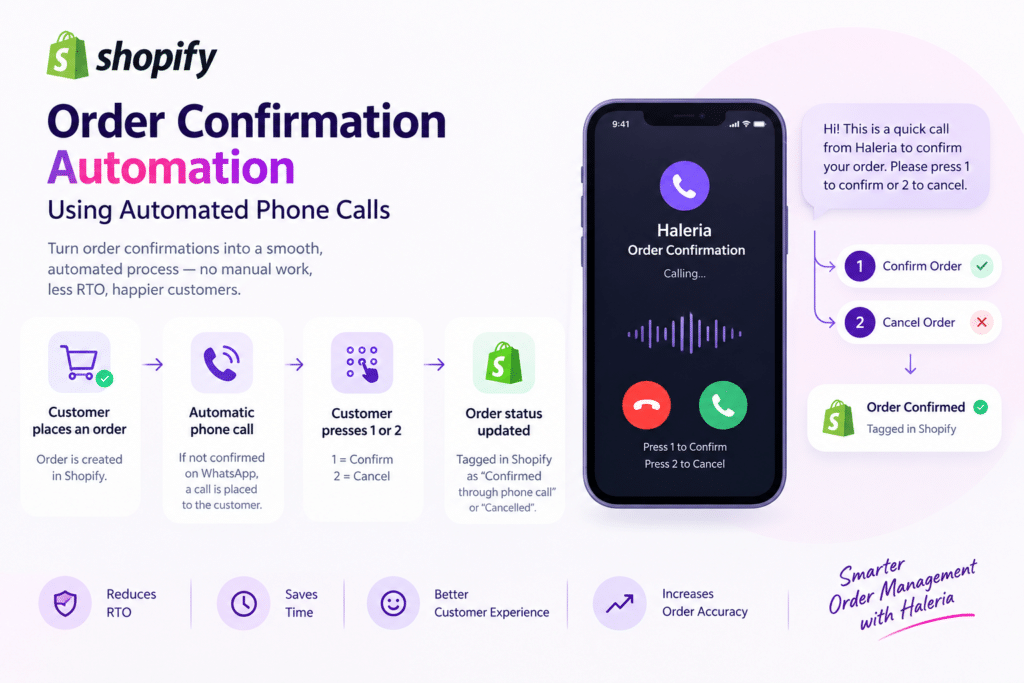
With an automated phone confirmation system, the process can work as follows:
- A customer places an order: The order enters the Shopify store.
- An automated call is initiated: The system calls the customer using the configured workflow.
- The customer responds: The recorded prompt asks the customer to press 1 to confirm the order or press 2 to cancel it.
- The response is processed: The system records the customer’s selection and updates the relevant order information according to its configuration.
- A follow-up is scheduled: If the customer does not answer, the system can place another call after a configured interval.
This approach reduces the need for staff to dial every customer manually.
It also creates a more consistent process for handling confirmations and cancellations.
4. Seven Benefits of Automating Shopify Order Confirmations
Benefit 1: Save Time on Repetitive Tasks
Automated calls can handle routine confirmation requests without requiring an employee to dial each number individually.
For stores receiving hundreds or thousands of monthly orders, reducing repetitive calling can make daily operations easier to manage.
The time saved can be redirected toward fulfillment coordination, customer inquiries, product improvements, and marketing activities.
Benefit 2: Collect Clear Customer Responses
A simple keypad-based workflow gives customers a straightforward way to respond.
- Press 1 to confirm the order.
- Press 2 to cancel the order.
Instead of relying entirely on manual conversations, merchants can collect structured responses that help their teams determine the next step.
However, a confirmation response should be interpreted as an indication of customer intent, not a guarantee that the customer will accept the delivery.
Benefit 3: Follow Up on Unanswered Calls
Not every customer will answer the first call. They may be working, driving, attending a meeting, or simply unable to reach their phone.
An automated follow-up workflow can schedule another attempt after a predefined interval.
This helps merchants maintain a consistent verification process without asking staff to remember every missed call.
Follow-up timing should be configured thoughtfully, with suitable calling hours and reasonable limits on repeated attempts.
Benefit 4: Improve Order Processing Efficiency
When confirmation responses are recorded systematically, fulfillment teams can identify orders that need attention.
Depending on the app’s integration and settings, confirmed and cancelled responses may be reflected through order tags, status updates, or other records.
This can help teams organize their work and reduce confusion between orders awaiting verification and those ready for the next processing step.
Merchants should always configure cancellation handling carefully to avoid unintentionally disrupting legitimate orders.
Benefit 5: Support Business Growth Without Matching Every Order With More Manual Work
As order volume increases, a fully manual confirmation process may require additional staff time.
Automation can help businesses handle routine tasks more consistently while keeping employees available for exceptions and more complex customer issues.
It does not eliminate the need for customer service. Instead, it allows teams to focus their attention where human assistance provides the most value.
Benefit 6: Create a More Consistent Customer Experience
A well-designed confirmation call communicates that the business has received the order and provides a clear opportunity to confirm or cancel it.
Consistent messaging can reduce confusion about what happens next.
For US and UK merchants, it is important to use clear English voice prompts, appropriate local calling hours, and a recognizable business identity wherever supported.
Benefit 7: Make Order Verification Easier to Measure
Automation can make it easier to review operational metrics such as:
- Total confirmation calls initiated.
- Answered and unanswered calls.
- Confirmation and cancellation responses.
- Follow-up attempts.
- Time spent on manual verification.
- Orders requiring staff intervention.
Tracking these metrics helps merchants evaluate whether automation is improving efficiency and where the workflow needs adjustment.
5. Automated Calls vs. Manual Confirmation: What’s the Difference?
| Feature | Manual calling | Automated confirmation calls |
|---|---|---|
| Initiating calls | Employee dials each customer | Calls can be triggered automatically |
| Customer response | Employee records the response | Keypad responses can be captured automatically |
| Missed calls | Employee must track follow-ups | Follow-ups can be scheduled |
| Record keeping | May involve manual updates | Can be integrated with order records |
| Staff involvement | Required for each routine call | Mainly needed for exceptions and support |
| Scalability | Workload grows with call volume | Routine tasks can be handled more efficiently |
The best approach depends on the store’s order volume, customer preferences, budget, and operational requirements.
Some merchants may prefer a hybrid workflow in which automated calls handle routine confirmations while staff members handle unusual cases.
6. Is Automated Order Confirmation Useful for US and UK Shopify Stores?
Automated confirmation calls can be useful for merchants in both markets, particularly when phone verification is an important part of their order management process.
However, the ideal workflow depends on the business model.
For Shopify stores in the United States
Merchants can consider automated order verification when they need a consistent process for checking customer intent before fulfillment.
For eligible orders, an automated call can offer a simple confirmation or cancellation option without requiring staff to make every call manually.
Businesses should also consider their payment methods, fulfillment policies, customer communication preferences, and applicable calling regulations.
For Shopify stores in the United Kingdom
UK merchants can use similar workflows to reduce repetitive administrative tasks and improve consistency in order handling.
Calling schedules should account for the customer’s local time, and businesses should ensure that their communication practices comply with applicable privacy and electronic communications requirements.
Important: Automated calls are not necessary for every order. Merchants should decide which orders require verification and configure the workflow accordingly.
7. How Haleria Helps Shopify Merchants Automate Confirmation Calls
Haleria AI Sales & Support helps Shopify merchants streamline customer communication and order-related workflows.
Its automated order confirmation call feature is designed to reduce the manual effort involved in contacting customers after an order is placed.
With Haleria’s phone confirmation workflow, merchants can:
- Initiate automated calls: Trigger confirmation calls for new orders through the configured workflow.
- Offer keypad confirmation: Customers can press 1 to confirm or press 2 to cancel.
- Schedule follow-up calls: If the initial call is unanswered, another attempt can be scheduled after a configured interval.
- Reduce repetitive calling: Staff members spend less time manually contacting customers for routine confirmations.
- Streamline order handling: Customer responses help merchants identify orders that need further processing or attention.
For a store receiving 2,200 orders each month, the earlier example illustrates how manual confirmation calls could account for approximately 110 hours of work if each call takes three minutes.
The actual time saved with automation will depend on the workflow, customer response rates, follow-up requirements, and the amount of manual work eliminated.
Rather than promising that every order will be confirmed or every return will be prevented, the goal is to make order verification more consistent and manageable.
8. What Should You Check Before Choosing a Shopify Order Confirmation App?
Before installing an automation solution, review the following factors.
Shopify integration
Confirm that the app integrates with your Shopify store and supports the order events and records required by your workflow.
Call automation
Check whether calls can be initiated automatically when an order is placed and whether the system supports the required confirmation options.
Follow-up settings
Look for configurable follow-up intervals, retry limits, and calling-hour controls.
Order response tracking
Understand how confirmation and cancellation responses are recorded and whether order tags or other updates can be configured.
Pricing and call costs
Review subscription fees, phone number costs, usage charges, and any additional fees for follow-up attempts.
Privacy and compliance
Review the app’s privacy policy, data handling practices, and support for your legal obligations. Depending on the circumstances, automated calls may be subject to consent, identification, calling-time, and other requirements.
For UK businesses, consult the relevant guidance from the Information Commissioner’s Office. US businesses should review applicable Federal Trade Commission and Federal Communications Commission requirements.
Reporting and support
Choose a solution that helps you understand call outcomes and provides support when the workflow needs troubleshooting.
9. Frequently Asked Questions
What is the best way to automate Shopify order confirmations?
The best approach depends on your customers and business model. Shopify merchants can evaluate automated phone calls, messaging integrations, and other order management tools to find a workflow that meets their operational requirements.
Can Shopify orders be confirmed automatically by phone?
Yes. With a compatible order confirmation app, a call can be initiated automatically after an order is placed. Customers can respond through keypad options, such as pressing 1 to confirm or 2 to cancel.
What happens if a customer does not answer the confirmation call?
Some automation solutions support scheduled follow-up calls. Merchants can configure an appropriate interval and retry limit so that unanswered calls are handled consistently.
How much time can automated order confirmation save?
Savings depend on order volume and average manual handling time. For example, 2,200 calls at three minutes each represent 110 hours of initial calling time per month. Actual savings will be lower or higher depending on the work automated and the follow-up process.
Does automated order confirmation eliminate failed deliveries?
No. Confirmation calls can help merchants identify customer responses before fulfillment, but they cannot guarantee delivery acceptance. Incorrect addresses, customer availability, changes of mind, and carrier issues can still cause delivery failures.
Is Haleria suitable for Shopify stores in the US and UK?
Haleria offers automated order confirmation call functionality for supported markets. Merchants should verify current country availability, phone number requirements, pricing, and setup requirements before getting started.
Conclusion: Make Shopify Order Management More Efficient
Manual order confirmation may be manageable when a store is small, but it can become a significant operational burden as order volume grows.
Shopify order confirmation automation gives merchants a way to initiate calls, capture customer responses, schedule follow-ups, and reduce repetitive administrative work.
For growing ecommerce businesses in the US and UK, the benefit is not simply making fewer calls manually. It is creating a more consistent order verification process while freeing up staff time for customer experience and business growth.
If your team spends hours every month confirming orders, explore whether automated phone confirmation could simplify your workflow.
Discover Haleria AI Sales & Support and explore how Shopify order confirmation automation can help streamline your store operations.