
Table of Contents
Businesses have spent years adopting software to make everyday work easier. From managing customer relationships to handling sales, marketing, and customer support, SaaS (Software as a Service) has changed how companies operate.
But something new is happening.
Instead of simply giving people software to complete their work, businesses are beginning to use AI agents that can actually perform tasks on their behalf.
Imagine telling a system to follow up with potential customers, answer their questions, update your CRM, and prepare a sales report. Rather than completing each step yourself, an AI agent can handle the entire workflow with minimal human involvement.
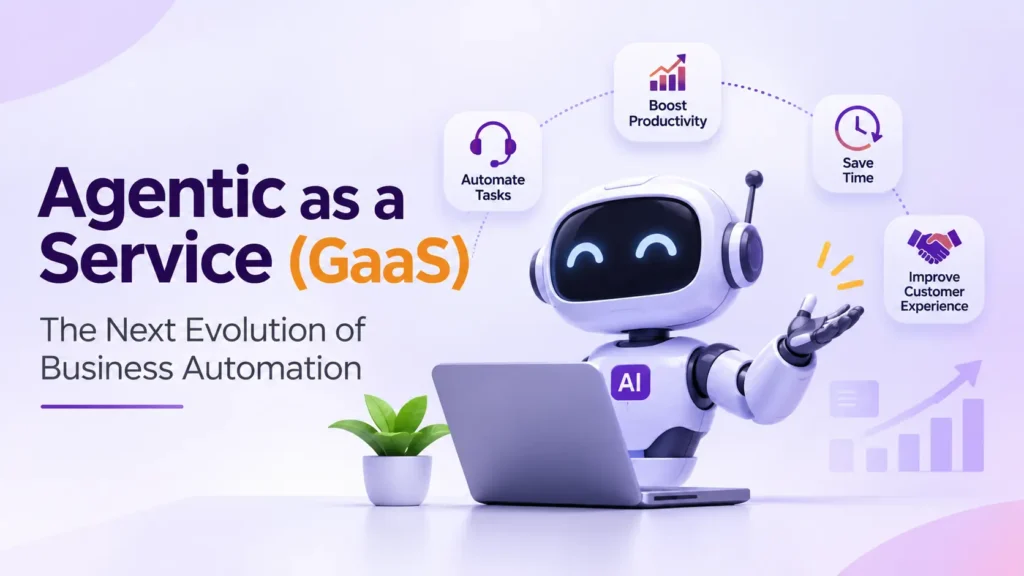
This is where Agentic as a Service (GaaS) comes in.
GaaS represents a shift from software that helps people work to intelligent systems that can take action and complete tasks. It is changing how businesses think about automation, productivity, and customer experience.
Let’s understand what Agentic as a Service means, how it works, and why it matters for modern businesses.
Quick Answer: What Is Agentic as a Service (GaaS)?
Agentic as a Service (GaaS) is a service model that provides businesses with AI agents capable of understanding goals, making decisions, using connected tools, and completing multi-step tasks with limited human supervision.
Unlike traditional SaaS applications, which mainly provide tools for users to operate, GaaS focuses on getting work done.
For example, a traditional CRM helps a sales representative manage customer information. An agentic AI system can identify potential leads, research prospects, send personalized follow-ups, update customer records, and notify the sales team when someone is ready to buy.
The main difference is simple: SaaS provides the software, while GaaS provides intelligent task execution.
What Is Agentic as a Service?
Agentic as a Service is an emerging service model built around autonomous or semi-autonomous AI agents.
These agents are designed to work toward specific goals rather than simply responding to individual instructions. They can understand a request, break it into smaller tasks, select appropriate tools, and execute different steps to reach the desired outcome.
Think about a business that receives hundreds of customer inquiries every day.
With traditional software, employees might need to open customer records, check order details, respond to questions, and update the system manually.
With an agentic AI solution, an agent can receive a customer request, retrieve relevant information, check the order status, prepare a response, and update the connected system when authorized.
This is what makes Agentic as a Service different from basic automation.
It is not just about following a fixed sequence of commands. It is about understanding a goal and deciding how to work toward it within defined permissions.
How Does Agentic as a Service Work?
An agentic AI system combines several technologies to complete tasks. Although implementations differ, most systems follow a similar process.
1. Understanding the Goal
Everything begins with an instruction or business objective.
For example, a company might ask an AI agent to follow up with customers who have shown interest in a product but haven’t completed their purchase.
The agent first identifies what needs to be achieved.
2. Breaking Work Into Smaller Tasks
Instead of treating the instruction as one large request, the agent divides it into manageable steps.
For example:
- Identify customers who abandoned their carts.
- Retrieve relevant customer and product information.
- Prepare personalized follow-up messages.
- Send messages within approved communication rules.
- Track customer responses.
3. Using Connected Tools
AI agents can connect with external tools and business applications through APIs and integrations.
Depending on their permissions, they may interact with:
- CRM platforms
- Email marketing systems
- Shopify and other eCommerce platforms
- Customer support software
- Project management tools
- Databases and reporting systems
These connections allow agents to perform actions instead of simply generating recommendations.
4. Taking Action and Monitoring Results
Once the necessary information is available, the agent performs the assigned tasks.
It can also monitor the results, identify unsuccessful steps, and decide whether another action is needed.
For sensitive activities, such as issuing refunds, approving payments, or sending important communications, businesses should establish permission controls and human approval processes.
5. Reporting the Outcome
After completing the workflow, the agent can provide a summary of what happened.
For example, it might report how many customers were contacted, how many responded, and how many completed their purchases.
The goal is to give businesses visibility into the work being performed.
Agentic as a Service vs SaaS: What’s the Difference?
SaaS and GaaS are not necessarily competitors. In many cases, they can work together.
However, their primary value propositions are different.
SaaS gives users access to software applications that help them perform tasks. GaaS provides AI agents that can execute tasks and workflows on behalf of users.
Consider a simple example of managing sales leads.
With SaaS, a sales representative opens a CRM, reviews customer information, sends emails, and updates records.
With GaaS, an AI agent can identify suitable leads, research their businesses, prepare personalized messages, send approved outreach, and update the CRM.
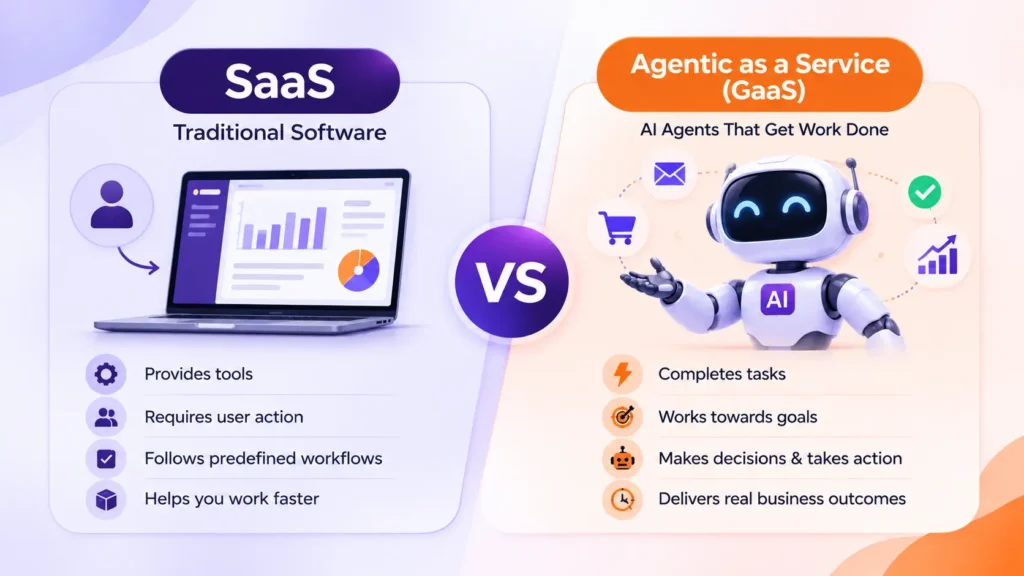
Here is a quick comparison:
| Feature | SaaS | GaaS |
|---|---|---|
| Main purpose | Provides software | Provides task execution |
| User involvement | Users operate the software | Users define goals and supervise |
| Work approach | Mostly user-driven | Agent-driven |
| Automation | Rules and predefined workflows | Goal-oriented, adaptive workflows |
| Decision-making | Primarily human-controlled | AI-assisted or autonomous within permissions |
| Value proposition | Access to tools | Completion of tasks |
| Pricing | Subscription-based in many cases | Usage, task, outcome, or subscription-based |
The biggest difference is how work gets completed.
SaaS helps people do their jobs more efficiently. GaaS aims to take responsibility for specific parts of those jobs.
Real-World Examples of Agentic as a Service
Agentic AI is becoming relevant across different industries. Here are some practical ways businesses can use it.
1. Sales and Lead Generation
Sales teams spend considerable time finding prospects, researching companies, preparing outreach messages, and following up.
An AI sales agent can help with these activities by:
- Finding potential customers based on defined criteria.
- Researching company websites and business information.
- Preparing personalized outreach messages.
- Scheduling follow-ups.
- Updating CRM records.
- Identifying prospects who show buying interest.
This gives sales representatives more time to focus on conversations, negotiations, and closing deals.
2. Customer Support Automation
Customer support is another area where agentic AI can make a difference.
An AI support agent can understand customer questions, retrieve information from a knowledge base, check order details, and help resolve common issues.
For an eCommerce business, this could include answering questions about product availability, shipping, returns, and order status.
More complex or sensitive cases can be transferred to a human support representative.
3. Marketing Automation
Marketing involves several connected activities, from content planning to campaign management and performance analysis.
An AI marketing agent can help businesses:
- Research relevant topics and keywords.
- Prepare content briefs.
- Draft social media posts.
- Organize campaign schedules.
- Analyze campaign performance.
- Recommend improvements based on results.
With the right integrations and permissions, some of these tasks can also be executed automatically.
4. Finance and Accounting
Finance departments handle repetitive processes that require accuracy and proper documentation.
Agentic AI can assist with invoice processing, transaction categorization, expense reviews, and financial reporting.
For example, an agent could extract invoice information, match it with purchase records, flag inconsistencies, and prepare entries for human approval.
Financial decisions and payments should remain subject to appropriate controls.
5. Human Resources
HR teams manage recruitment, employee communication, onboarding, and administrative tasks.
An AI HR agent can help organize applications, identify candidates who meet predefined requirements, schedule interviews, and prepare onboarding documents.
This reduces administrative work and allows HR professionals to focus on evaluating candidates and supporting employees.
Benefits of Agentic as a Service for Businesses
The growing interest in GaaS is not just about adopting another AI technology. Businesses are interested in what it can actually accomplish.
Here are some of its major benefits.
Reduced Manual Work
Employees often spend hours completing repetitive tasks. Agentic AI can handle suitable workflows automatically, reducing the need for constant manual involvement.
Improved Productivity
When agents take care of routine activities, employees can spend more time on strategic decisions, customer relationships, and important business operations.
Faster Task Execution
An AI agent can perform several connected steps without requiring a person to manually move between different applications for every action.
Better Scalability
As a business grows, its workload usually increases. Agentic AI can help manage additional tasks without requiring the same level of growth in manual administrative work.
However, scaling still depends on infrastructure, costs, system reliability, and the complexity of the tasks involved.
Connected Business Operations
Instead of working with separate tools that require manual updates, AI agents can coordinate activities across connected platforms.
This creates opportunities for more organized business processes.
Challenges and Limitations of Agentic as a Service
Despite its potential, Agentic as a Service is not a solution for every business problem.
There are important challenges that companies should consider before adopting it.
Data Privacy and Security: AI agents may access sensitive business information. Companies need proper access controls, secure integrations, and clear data-handling policies.
Incorrect Decisions: AI agents can misunderstand instructions or produce incorrect results. Human oversight is particularly important for high-impact decisions.
Integration Complexity: Connecting agents with existing business systems can require technical expertise and careful configuration.
Operational Costs: Running AI agents may involve model usage, API calls, computing resources, and third-party service charges. Costs can increase with complex or lengthy workflows.
Trust and Accountability: Businesses need to understand what an agent is allowed to do, what actions it has taken, and who is responsible when something goes wrong.
The best approach is to start with clearly defined, low-risk workflows and gradually expand as reliability improves.
How Is GaaS Changing the Future of SaaS?
The traditional SaaS model has been built around providing users with access to software through subscriptions.
But customer expectations are changing.
Businesses no longer want to spend unnecessary time navigating multiple applications just to complete simple tasks. They increasingly want solutions that can understand their requirements and take action.
This doesn’t mean SaaS is disappearing.
In fact, SaaS platforms may become the foundation on which agentic services operate. They provide the databases, integrations, workflows, and infrastructure that AI agents need to perform their work.
The shift from SaaS to GaaS is better understood as an evolution in how software delivers value.
Instead of measuring value only through the features available in an application, businesses may increasingly measure it through the actual work completed.
For SaaS companies, this creates an opportunity to move beyond traditional software subscriptions and introduce AI-powered services that deliver measurable business outcomes.
Is Agentic as a Service the Right Choice for Your Business?
GaaS can be useful for businesses that manage repetitive, time-consuming, and multi-step processes.
However, adopting agentic AI simply because it is a growing trend is not a good strategy.
Start by identifying tasks that consume significant employee time but follow relatively clear business rules.
For example:
- Customer inquiry management.
- Lead research and follow-ups.
- Order status communication.
- Data entry and reporting.
- Appointment scheduling.
- Internal workflow coordination.
Next, evaluate whether an AI agent can complete these tasks reliably using your existing systems.
Start small, measure the results, and expand the implementation when the benefits are clear.
The objective should not be to replace every human activity. It should be to remove unnecessary manual work and give employees better tools to focus on what matters.
Final Thoughts
Agentic as a Service represents an important development in how businesses use technology.
For years, software has helped people organize information and complete tasks. Now, AI agents are making it possible to delegate entire workflows to intelligent systems that can understand instructions, use tools, and take action.
SaaS is about providing access to software. GaaS takes the next step by focusing on execution.
Although the technology still has limitations, its potential across sales, marketing, customer support, finance, and operations is worth exploring.
The businesses that understand how to combine AI agents with human expertise may find new ways to improve productivity, reduce operational workloads, and deliver better customer experiences.
The future of business software may not be about how many tools a company uses, but how much meaningful work those tools can actually get done.
Frequently Asked Questions (FAQs)
1. What does GaaS stand for?
GaaS can stand for different things depending on the context. In this article, it refers to Agentic as a Service: a model that provides AI agents capable of performing tasks and managing workflows on behalf of businesses.
2. What is Agentic as a Service?
Agentic as a Service is an emerging model in which businesses use AI agents to understand goals, make decisions, interact with connected tools, and complete multi-step tasks with limited human supervision.
3. What is the difference between SaaS and GaaS?
SaaS provides users with access to software applications, while GaaS focuses on providing AI-powered task execution. SaaS helps users perform work through software, whereas GaaS enables agents to perform defined work on their behalf.
4. How do AI agents work?
AI agents receive instructions, understand objectives, break tasks into smaller steps, access connected tools, and execute actions. Depending on their configuration, they can also monitor results and adjust their approach.
5. Is Agentic as a Service suitable for small businesses?
Yes. Small businesses can use agentic AI for customer support, lead management, marketing operations, and administrative tasks. The best starting point is a simple workflow that saves time without introducing unnecessary complexity.
6. Is GaaS replacing SaaS?
No. GaaS is more accurately viewed as an evolution of software services rather than a complete replacement for SaaS. Many AI agents depend on existing SaaS platforms, APIs, and business systems to perform their tasks.
7. How is Agentic as a Service priced?
Pricing models can include monthly subscriptions, usage-based billing, API consumption, task-based charges, or outcome-based pricing. The actual model depends on the provider and the complexity of the service.
8. What industries can benefit from Agentic as a Service?
Industries such as eCommerce, healthcare administration, finance, marketing, customer support, logistics, and human resources can benefit from agentic AI when suitable workflows can be automated safely.